Most Deltona homeowners don't think about their HVAC system until the first genuinely hot day of spring — and by then, every technician in Volusia County is booked out for weeks. That's the timing trap. In a city where summer arrives fast, runs long, and pushes humidity well past comfortable, waiting until you feel the heat is already too late.
Deltona's climate doesn't follow a traditional four-season pattern. Your AC runs nearly year-round, which means wear accumulates faster than the national average. The homeowners who get ahead of that cycle — scheduling maintenance in late winter or early fall — consistently see fewer emergency calls, lower energy bills, and longer equipment life.
TL;DR Quick Answers
When is the best time for HVAC maintenance in Deltona?
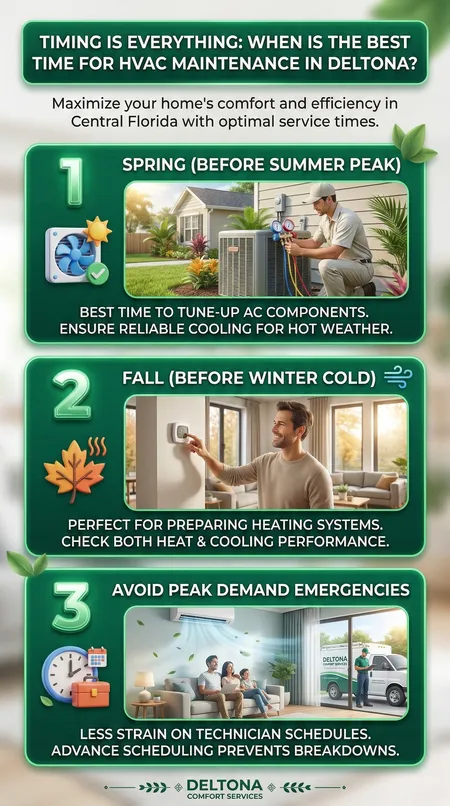
Best window: Late February through mid-March, before the cooling season begins.
Second-best window: October through November, after peak summer demand ends.
Why it matters: Deltona's subtropical climate means systems run 10–12 months per year, accelerating wear and increasing the risk of peak-season failures.
Minimum frequency: Once per year; twice per year is strongly recommended for Florida homes.
Biggest local risk: Skipping pre-summer maintenance in a high-humidity environment leads to coil fouling, refrigerant issues, and dirty blower components — all of which compound quickly.
Top Takeaways
Schedule pre-season maintenance in late February or early March — before demand peaks and before the heat arrives.
Deltona systems work harder than most — year-round subtropical operation means annual wear equivalent to two years in cooler climates.
Condensate drain maintenance is non-negotiable in Florida's humidity; clogs cause water damage fast.
Fall maintenance in October–November is a strong second window for post-summer recovery and heating prep.
Twice-yearly service is the smart play for any Deltona home with a system older than five years.
Why Timing Matters More in Deltona Than Most Places
Deltona sits in Central Florida's subtropical zone, where average summer temperatures exceed 90°F and relative humidity regularly climbs above 70%. That combination puts extraordinary strain on residential HVAC systems.
Most U.S. climates allow an HVAC system to "rest" during mild shoulder seasons. In Deltona, that rest period barely exists. Your system may cycle on even in January during warm stretches, meaning annual wear is closer to what northern systems experience every two years.
The Pre-Summer Window: Late February to Mid-March
This is the single most important maintenance window for Deltona homeowners.
Scheduling service before the cooling season offers four distinct advantages:
Technician availability is highest. Peak demand hits in May and June. February appointments are easy to book.
Problems are found before they become emergencies. A refrigerant issue discovered in March is a service call. The same issue discovered in July is a 90-degree house with a two-day wait.
Efficiency is restored before it costs you. A dirty evaporator coil can reduce system efficiency by 15–25% before you even notice a performance change.
Air quality resets after winter. Even in Florida, winter brings reduced airflow, organic buildup in drain pans, and potential microbial growth in humid ductwork.
The Post-Summer Window: October to November
If you missed the spring window, October is your recovery point.
After months of maximum operation, your system has accumulated significant wear. Fall maintenance accomplishes three things:
Clears debris, biological growth, and contaminants from a hard summer season
Evaluates components before the mild winter heating period
Identifies early wear patterns before they become winter failures
In Deltona, the heating season is short but real. Strip heat and heat pump efficiency matter during January cold snaps, and a fall tune-up ensures both are working correctly.
What Maintenance Should Include in This Climate
Standard HVAC maintenance checklists were designed for more forgiving climates. In Deltona, a quality tune-up should specifically address:
Evaporator and condenser coil cleaning — high humidity accelerates fouling
Condensate drain inspection and flush — clogged drains are the top cause of water damage in Florida homes
Blower wheel cleaning — Deltona's oak pollen and fine particulates accumulate faster than in drier regions
Refrigerant pressure verification — heat stress causes microfissures that result in slow leaks over time
Capacitor and contactor testing — these components fail at higher rates in high-heat environments
Filter assessment and replacement — a clogged filter in July can cause a freeze-up within hours
"In our experience serving Central Florida homes, the biggest mistake we see is homeowners scheduling maintenance after something goes wrong. In a climate like Deltona's — where the system never truly rests — preventive care isn't optional. It's the difference between a $150 tune-up and a $3,000 emergency repair at the worst possible time."
Essential Resources on "HVAC Maintenance in Deltona"
1. U.S. Department of Energy — Heating and Cooling Tips
The DOE offers practical guidance on HVAC efficiency, maintenance schedules, and energy-saving best practices for residential systems.
https://www.energy.gov/energysaver/home-heating-systems
2. EPA — Indoor Air Quality and HVAC Systems
The EPA's indoor air quality resources explain how HVAC maintenance directly affects airborne pollutants, humidity control, and respiratory health inside the home.
https://www.epa.gov/indoor-air-quality-iaq
3. ENERGY STAR — HVAC Maintenance Guidance
ENERGY STAR provides homeowner-focused maintenance checklists and efficiency benchmarks for residential cooling and heating systems.
https://www.energystar.gov/saveathome/heating_cooling
4. ASHRAE — Residential HVAC Standards
The American Society of Heating, Refrigerating, and Air-Conditioning Engineers publishes the technical standards that define proper HVAC service procedures and system performance.
https://www.ashrae.org/technical-resources/standards-and-guidelines
5. Florida Department of Agriculture and Consumer Services — Contractor Licensing Verification
Homeowners can verify HVAC contractor licenses before scheduling service in Florida through the state's official licensing portal.
https://www.myfloridalicense.com/wl11.asp
6. Volusia County — Emergency Management and Extreme Heat Resources
Volusia County's emergency management resources include guidance on heat-related risks and home comfort preparedness for local residents.
https://www.volusia.org/services/public-protection/emergency-management/
7. Building Performance Institute (BPI) — Home Performance Standards
BPI provides nationally recognized standards for home energy audits and HVAC system performance assessment, helping homeowners understand whole-home efficiency.
Supporting Statistics
The Department of Energy estimates that HVAC systems account for approximately 43% of a home's total energy consumption — making maintenance the single highest-impact action a homeowner can take on energy costs. In Deltona, where cooling runs nearly year-round, that share is likely even higher.
Source: https://www.energy.gov/energysaver/heating-cooling
The EPA reports that indoor air can be 2 to 5 times more polluted than outdoor air, a figure that worsens significantly when HVAC systems go without maintenance and allow biological growth and particulate buildup in ducts and coils. For Deltona homeowners running systems in closed homes most of the year, this is a meaningful health consideration.
Source: https://www.epa.gov/report-environment/indoor-air-quality
ENERGY STAR data indicates that a properly maintained HVAC system can reduce energy bills by up to 30% compared to a neglected system. Given Deltona's 10–12 month cooling demand, that gap compounds faster than in most U.S. markets — making the ROI on a tune-up exceptionally clear.
Source: https://www.energystar.gov/saveathome/heating_cooling
Final Thought & Opinion
The question isn't really whether to schedule HVAC maintenance in Deltona — it's when. And the honest answer is: earlier than most people think.
Deltona's climate is genuinely hard on HVAC equipment. High humidity accelerates corrosion and biological growth. Near-constant operation wears capacitors and contactors faster than the manufacturer's average ratings. And a failure in July doesn't just mean discomfort — it means days of waiting for an available technician during the busiest season of the year.
The homeowners who fare best share one consistent habit: they treat HVAC maintenance like a scheduled bill, not an emergency response. Late February or early March, every year. It's not complicated — but it is the kind of local insight that makes a real difference when the Florida summer hits full force.
FAQ on "HVAC Maintenance in Deltona"
Q1: How often should I schedule HVAC maintenance in Deltona?
A: Twice per year is the recommended standard for Central Florida homes.
Spring tune-up: Late February to mid-March
Fall tune-up: October to November
Older systems (8+ years): Twice yearly without exception
Q2: What happens if I skip a year of HVAC maintenance in Florida?
A: Skipped maintenance leads to compounding issues:
Coil fouling reduces efficiency by 15–25%
Clogged condensate drains cause water damage
Worn capacitors fail without warning in peak heat
Air quality inside the home degrades measurably
Q3: Is HVAC maintenance really necessary in mild Florida winters?
A: Yes — for three reasons:
Even Florida winters stress heat pumps and strip heat components
Post-summer wear needs assessment before cooler months
Biological growth in drain pans continues year-round in humid conditions
Q4: What's the most important maintenance task specific to Deltona's climate?
A: Condensate drain cleaning is the highest priority.
Florida's humidity makes drain clogs nearly inevitable without regular flushing
Clogs cause pan overflow, water damage to ceilings and walls, and system shutdowns
Should be inspected and treated at every service visit
Q5: How do I know if my HVAC system needs maintenance right now, even outside the ideal windows?
Watch for these signs:
Rooms are cooling unevenly or taking longer than usual
Energy bills are rising without a clear weather explanation
Musty or stale odors from vents
Visible moisture or water around the indoor air handler
System cycling on and off more frequently than normal
Schedule Your HVAC Tune-Up Before the Season Hits
Don't wait for a 90-degree day to find out your system isn't ready. Book your HVAC maintenance in Deltona now — before the summer rush — and go into the cooling season with confidence.
Here is the nearest branch location serving the Deltona area. . .
Filterbuy HVAC Solutions
2900 Titan Row # 128, Orlando, FL 32809
(407) 204-1859
https://maps.app.goo.gl/1VWkzrEiCyb4sKPT7b